
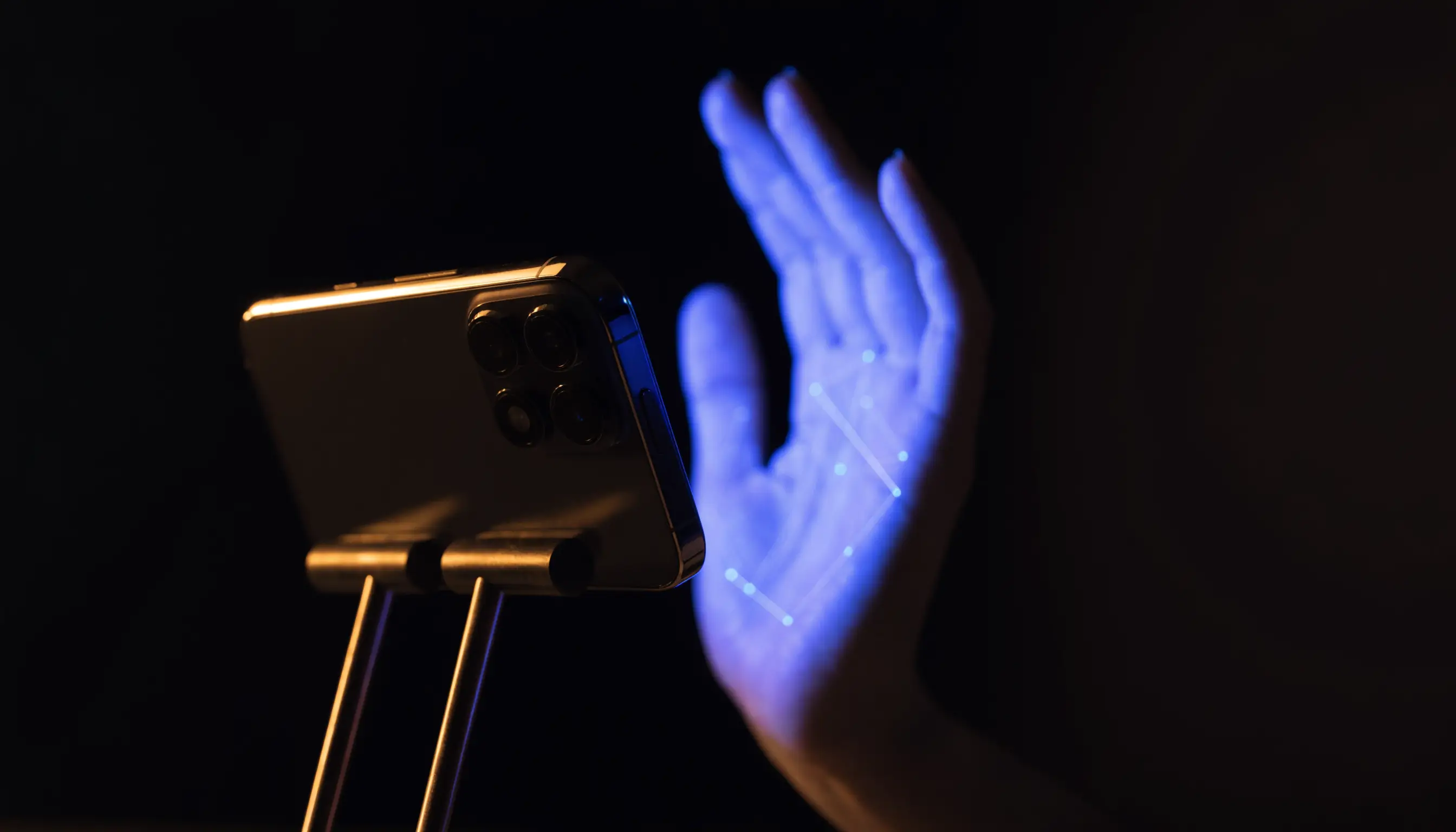
For years, measuring a hand well meant hardware. You needed a ruler, a reference card, or a store kiosk, and most customers simply skipped the step. Phone-based hand measurement changes that equation, because it puts the entire process on the device people already carry.
That shift sounds small, yet it reshapes how brands think about fit. After all, a measurement only helps if customers actually complete it. Therefore, removing the hardware is not a convenience feature — it is the whole point.
The problem phone-based hand measurement solves
Traditional sizing forces a trade-off. You can ask for very little and accept guesswork, or you can ask for careful measurements and watch most customers give up. Neither path ends well.
A ruler at home is unreliable. A printed reference card assumes a working printer and a steady hand. A store kiosk assumes the customer is in the store at all. As a result, the richest fit data has always lived behind the highest friction.
Phone-based hand measurement removes that wall. Instead of hardware, it uses a guided capture on the phone, so the customer follows simple prompts and the geometry comes back automatically. Consequently, the brand gets better data without asking the customer to work harder.
Why fit data has stayed so coarse
Most size charts ask for one or two numbers because that is all customers will tolerate. However, a hand is not a single number. It has length, breadth, circumference, finger proportions, a thumb, and a wrist, and each of those shapes how a glove sits.
When you can only collect a little, you can only recommend a little. Therefore, coarse input has quietly capped how good glove sizing can get — until the capture itself became easy.
How phone-based hand measurement works
The flow is simpler than it sounds. In practice, it breaks into three clear stages, and each one does a specific job.
Capture
First, the customer follows a guided capture on their phone. There is no ruler, no reference card, no coin for scale, and no special hardware. Instead, on-screen prompts walk them through it, which keeps the experience short and forgiving.
Measure
Next, the system reads the hand and produces metric geometry. For example, it works with hand length, palm breadth, circumference, finger-root anchors, and wrist-related dimensions. In other words, it turns a quick capture into real numbers rather than a vague estimate.
Output
Finally, the measurements become a hand-geometry record. This record is the asset, not a one-time size guess. As a result, the same data can power several decisions instead of disappearing after a single checkout.
Why phones beat rulers, cards, and kiosks
The advantages stack up quickly. When you compare phone-based hand measurement to the old tools, a few benefits stand out:
- Reach. Nearly every customer already owns a capable phone.
- Completion. A guided capture is faster than hunting for a ruler, so more people finish.
- Consistency. Prompts reduce the random errors that come from measuring by hand.
- No hardware cost. Brands avoid kiosks, scanners, and store fixtures entirely.
- Anywhere. The customer can measure at home, on the couch, or mid-purchase.
Therefore, the phone is not just one more option. In fact, it is the first capture method most customers will actually use at scale.
What brands can do with the data
A good measurement is only valuable if it does something. The record makes that easy, because one capture can feed many workflows. For instance, brands can use it to:
- Recommend a confident size for off-the-shelf products.
- Apply fit rules that flag styles running tight or loose.
- Configure adjustable or modular products to the hand.
- Drive made-to-measure pattern logic for bespoke builds.
Moreover, the same record can sit behind your own sizing flow. That way, the customer stays inside your brand experience, and you keep both the relationship and the data. As a result, the measurement strengthens your funnel instead of handing customers off to a third party.
Partner-agnostic by design
Good infrastructure does not lock you in. A strong measurement layer stays partner-agnostic, which means it is not tied to any single brand's size chart. Instead, it maps to yours. Therefore, two different brands can use the same underlying capture while each keeps its own sizing language.
Honesty about where the technology stands
It would be easy to overclaim here, and that is exactly the trap to avoid. Phone-based hand measurement is promising, but it is also early, and serious teams say so plainly.
Hand Measured, for example, runs on a working iOS prototype with patent-pending technology. The team is actively validating its anatomical anchors and camera-measurement behavior, and it deliberately holds back accuracy numbers until the work supports them. In short, the posture is confident about the direction and honest about the stage.
That honesty is not a weakness. On the contrary, when fit data matters, overclaiming is the fastest way to lose a partner's trust. Therefore, a measured, validated approach is the credible one.
Getting started with phone-based hand measurement
You do not need to rebuild your stack to explore this. A sensible first step is a conversation about your catalog, your categories, and the fit problems that cost you the most.
From there, a pilot can show what a guided capture looks like for your products, what data it needs, and how it would tune to your sizing system. As a result, you learn quickly whether the approach fits — without a long commitment up front.
The takeaway is simple. Phone-based hand measurement turns a high-friction step into a quick one, and it turns a one-time guess into durable fit data. For brands where fit decides the sale, that combination is hard to ignore.
If fit matters to your product, it is worth a closer look.